
My inbox lately has been increasingly clogged with dire warnings. I have been told that I am likely to be poisoned from breathing oil fumes, swept into oblivion by a giant methane-explosion-induced tsunami moving at 600 miles per hour, cast into poverty by foreign investors calling in their loans to the US, murdered by a band of unchecked immigrants, blown up by a terrorist I thought was my harmless neighbor tending his garden, subjected to a horrible curse if I fail to forward a message immediately to at least 10 friends, doomed to heart disease by a lifetime of eating huge quantities of "hidden" salt and sugar in commonplace foods... I could go on and on. The underlying message always is, "You should worry, worry, worry. Terrible things could happen."
And then, yesterday, I received a poignant e-mail letting me know that the brother of one of my colleagues at West Virginia University dropped dead, alone in the water, on a practice swim for a big swim event. He was an athlete. He had done that practice swim, which he loved, many times. He was only 58 years old. No one ever would have thought that this would happen to a healthy, hearty man in his prime. No one worried about him when he set off to swim with a smile and a wave to his family, as he did nearly every day. I was reminded that terrible things DO happen, but they are rarely the things we've been anticipating.
The real message we get from life, if we listen, is: Worry is pointless. Worry erodes our health, our sense of wellbeing, and our ability to enjoy the present moment. Anything could happen any time. We can't predict disaster, and we can't predict wonderful surprises, either. All we can know for sure is what HAS happened and what IS happening, right now.
But too often, we miss what IS happening because we are so caught up in ruminating about or regretting what HAS happened, which we cannot change, or in worrying and fretting about what COULD happen, which we cannot predict. So the precious gift of now is lost because our worried minds are elsewhere.
For years, I have taught resiliency and have told participants in my classes and seminars the facts about stress and worry, about what it does to the immune system and to the capacity of our minds and bodies to regain or sustain health. I have recommended the book Why Zebras Don't Get Ulcers to hundreds of students and colleagues, to share with them the scientific understanding of the price we humans pay for entertaining stress, worry and anxiety. I have recommended the books Second Chance and The Missing Link to hundreds of students and colleagues, to share with them the logic of the simplicity of living at ease in the present, free from stress, worry and anxiety. I always feel privileged to be able to point in the direction of health and peace of mind, and watch innate wisdom blossom in people as they see this for themselves.
I want to send a message to all those people anxiously poring over and urgently sending out frightening messages of imminent horror that the world, individually and collectively, should be worrying about constantly. Stop! Please, just stop. You have the best of intentions, but all this doom and gloom stuff is not helping to make the world a better, safer place. Indeed, it is keeping people on edge and off balance as they turn their minds away from life right now and helpful ideas that might occur to them from a quiet state of mind to think about scary things over which they have no control.
It makes sense, of course, to be prudent. But being prudent is not a product of worry. Prudence is wisdom applied to information, in neutral, in the present. Once we've done everything we can, it is pointless to think more about it. Thinking more about it and extrapolating fearful ideas from it generate worry.
It is prudent to know the news and read your mail and ask, "Is there anything I can do right now to address this situation?" If the answer is yes, it is prudent to do that. If the answer is no, there is no point thinking further about it. There is nothing I can do to prevent a giant tsunami, for example. Going over and over in my mind about how horrible that would be is a misapplication of my imagination, a way to use my own thinking to keep me from enjoying life now. Instead of playing with my dog and enjoying the beauty of nature when we take our walks, should I be ignoring the dog because I'm too upset to play, and plodding nervously through our walks wondering what the scene would look like as the giant wave strikes? Would that kind of thinking help me in any way?
A wise person, years ago, startled me out of a bout of worry, with this question: "If you knew you only had a few hours to live, is that how you would be using your mind?" Ever since then, worry has seemed like a waste of precious time to me. I cannot think of a single hour I've spent worrying that has contributed one iota to the quality of my life.
Ah, but the hours spent relishing beautiful sunsets, making up games with my grandson, tending to a growing plant, talking about constructive ideas with colleagues, immersing myself in beautiful music, writing a poem for an occasion, laughing at silly jokes, holding the hand of a dying friend and sharing good memories, cheering in the heat of an exciting sports event, picking up the phone to talk to somene I've missed, reflecting on a challenge and arriving at a surprising new answer -- those are the moments fully lived in the present. Those are the deposits in the account of a happy life.
I heard Bobby McFerrin interviewed on the radio recently. The interviewer said she wouldn't give in to the temptation to ask questions about the song "Don't worry, be happy!" because she was sure he was sick of people attaching his name only to that old, silly song, instead of his enormous body of subsequent creative work. He said he didn't mind talking about that song. A lot of people loved it. It cheered people up at a time they seemed to need that message. Essentially, his answer was, "Don't worry about what questions you ask me. Be happy we're here together now, talking about the power and beauty of music."
Remember the core idea of that little song? "In your life expect some trouble, but when you worry, you make it double."
Friday, July 2, 2010


Thursday, June 3, 2010
A Failure of Imagination
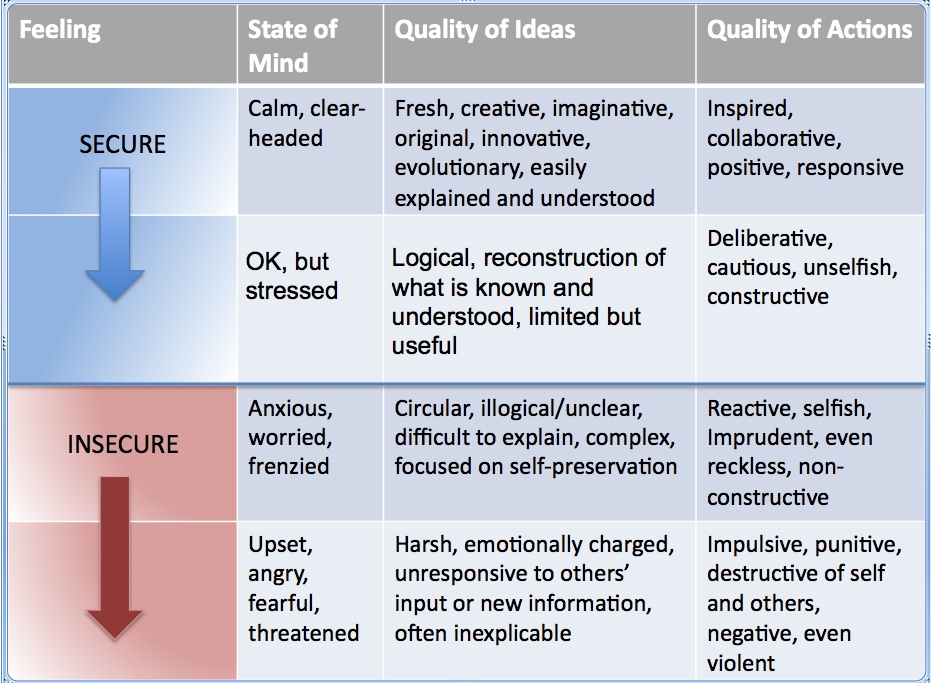
Insecurity, and all the non-constructive feelings it spawns, shoves wisdom and imagination out of its way when it overtakes our public dialogue. There is a highly predictable connection between the prevailing feeling state, or state of mind, in which we spend our time and the thinking and actions that make sense to us and seem possible to us.
It has been difficult to watch the erosion of common sense and wisdom as insecurity has infected more and more of our responses to critical issues over the past several weeks. It seems the news is filled with, and thriving on, reports of people in increasingly insecure states of mind struggling to deal with huge challenges. The missing piece in all our discussions seems to be the need for clarity, quiet minds, wisdom, insight and imagination to solve problems we've never seen before.
But there is hope in the innate and extraordinary resiliency we all share as human beings. We are always capable of dropping down from a secure state of mind that supports creative solutions to the most daunting problems, into insecurity, which blocks that capacity, as I've tried to illustrate in the chart below. But we are equally capable of turning around. At any moment, our heads clear, insight bubbles to the surface, we "see" what we're doing with out own thinking, and we can just as easily reverse the arrows and come back to peace and clarity.
What does it take? Wanting to feel less stressed; knowing that it's in us to be at ease with our thinking and elicit our highest quality ideas; trusting that the only way to keep negative thinking going is to hang onto it. As soon as we let any thought go, the natural flow of thinking resumes and the quality of our ideas and feelings, like everything else in life, moves towards balance.

It has been difficult to watch the erosion of common sense and wisdom as insecurity has infected more and more of our responses to critical issues over the past several weeks. It seems the news is filled with, and thriving on, reports of people in increasingly insecure states of mind struggling to deal with huge challenges. The missing piece in all our discussions seems to be the need for clarity, quiet minds, wisdom, insight and imagination to solve problems we've never seen before.
But there is hope in the innate and extraordinary resiliency we all share as human beings. We are always capable of dropping down from a secure state of mind that supports creative solutions to the most daunting problems, into insecurity, which blocks that capacity, as I've tried to illustrate in the chart below. But we are equally capable of turning around. At any moment, our heads clear, insight bubbles to the surface, we "see" what we're doing with out own thinking, and we can just as easily reverse the arrows and come back to peace and clarity.
What does it take? Wanting to feel less stressed; knowing that it's in us to be at ease with our thinking and elicit our highest quality ideas; trusting that the only way to keep negative thinking going is to hang onto it. As soon as we let any thought go, the natural flow of thinking resumes and the quality of our ideas and feelings, like everything else in life, moves towards balance.
Tuesday, May 25, 2010
Dreamers and Do-ers
In the past week or so, I've been privileged to be involved in two extraordinary gatherings that inspired people to imagine what is possible.
First, last week, more than 40 people from agencies and education and government in Manatee County came together at USF Sarasota-Manatee to join in the launch of an initiative representing a transformational dream for the 13th Street corridor in Bradenton, Florida. The leader of this initiative is Cynthia Newell, a powerful woman with joyful and unshakeable faith in the capacity for people to transcend anything, no matter what. She has a dream. But she's a do-er as much as a dreamer. And in two hours, educators, government officials, researchers, community members, service organization leaders, business people got involved, engaged and motivated to share the work of revitalizing a healthy, vibrant community in a declining neighborhood where, today, gangs rule, the unemployment rate is twice the national average, and many people -- not all -- have begun to lose hope for a bright tomorrow. C-4, she called the work: Collaborate, Connect, Create, Communicate.
As people talked and shared their hopes for re-awakening health and warmth and creativity and dignity all throughout that community, for keeping children safe to learn and challenging them to really envision their own potential and catch the fervor for moving towards it, for rebuilding and re-energizing the business heart that keeps the beat of progress, for bringing unlikely partners together to move toward a common goal, you could feel the warmth and love suffuse that room. We might became we can, as long as we work together.
Cynthia is a natural leader; she elicited the leadership in a room full of people ready to step together across the threshold of the unknown and envision greatness. They, in turn, will bring out the best in those with whom they work. And it will all start one soul at a time, as people realize their own resiliency and power and start to reinvent their lives.
And, yes, it will happen. It will because leaders like Cynthia and those who stand with her are filled with hope and passion and purpose and don't give in to their temporary self-doubts or insecurities. And it will happen because it is in the cards, a natural outcome for all people when they rediscover the source of their own wisdom and generate insights about their lives. I've seen the thrilling human dimension of the power to change so many times before, and it will be thrilling to see it and share in it here, in my home town.
Then, this week, I attended my first meeting as a Board member of Realize Bradenton, an organization that has been several years in the making with the intention to make the City of Bradenton a wonderful place to be, the kind of place you really want to spend time just walking around and taking it all in. So, not far at all from that 13th Street Corridor where Cynthia is making magic, Realize Bradenton is making magic, too. It's bringing artists, designers, musicians, planners, poets, landscape architects, builders -- more dreamers and do-ers -- together to make a nice town a great 21st-century community of friends and neighbors. Talk about imagining what's possible! They're talking about a meandering, walkable waterfront, serene little parks where people can find quiet and watch the Manatee River roll by and listen to the gulls and the sighing breezes, places for children to play, places for dogs to play, places to stand back and enjoy public art, wonderful galleries and shops mingled with all the cultural and educational attractions already there.
Once more I found myself in a room full of people brimming with respect for each other's ideas and the courage to think about the unexpected, the as-yet-unrealized possibilities of a little city that people have come to love but take for granted, sort of like a quiet old aunt. It's nice, and it's there for you, but it's all to easy to wave and pass on by.
So much has already been realized by this organization yet in its infancy, and so much more will happen soon. I thought about the charming artistic geckos that adorn so much commercial wall space now in Bradenton, and how they've made boring blank spaces quirky and appealing, worthy of a second look and some conversation. They started in someone's artistic thinking, someone who thought, "Why not?" and created a phenomenon from nothing. That's the power of the human mind set free.
It's wonderful to see, in these times when it too often feels like human relations are strained to the breaking point and all we hear is name-calling and blame-calling, that ordinary people can come together with love and hope in their hearts and accomplish extraordinary things.
First, last week, more than 40 people from agencies and education and government in Manatee County came together at USF Sarasota-Manatee to join in the launch of an initiative representing a transformational dream for the 13th Street corridor in Bradenton, Florida. The leader of this initiative is Cynthia Newell, a powerful woman with joyful and unshakeable faith in the capacity for people to transcend anything, no matter what. She has a dream. But she's a do-er as much as a dreamer. And in two hours, educators, government officials, researchers, community members, service organization leaders, business people got involved, engaged and motivated to share the work of revitalizing a healthy, vibrant community in a declining neighborhood where, today, gangs rule, the unemployment rate is twice the national average, and many people -- not all -- have begun to lose hope for a bright tomorrow. C-4, she called the work: Collaborate, Connect, Create, Communicate.
As people talked and shared their hopes for re-awakening health and warmth and creativity and dignity all throughout that community, for keeping children safe to learn and challenging them to really envision their own potential and catch the fervor for moving towards it, for rebuilding and re-energizing the business heart that keeps the beat of progress, for bringing unlikely partners together to move toward a common goal, you could feel the warmth and love suffuse that room. We might became we can, as long as we work together.
Cynthia is a natural leader; she elicited the leadership in a room full of people ready to step together across the threshold of the unknown and envision greatness. They, in turn, will bring out the best in those with whom they work. And it will all start one soul at a time, as people realize their own resiliency and power and start to reinvent their lives.
And, yes, it will happen. It will because leaders like Cynthia and those who stand with her are filled with hope and passion and purpose and don't give in to their temporary self-doubts or insecurities. And it will happen because it is in the cards, a natural outcome for all people when they rediscover the source of their own wisdom and generate insights about their lives. I've seen the thrilling human dimension of the power to change so many times before, and it will be thrilling to see it and share in it here, in my home town.
Then, this week, I attended my first meeting as a Board member of Realize Bradenton, an organization that has been several years in the making with the intention to make the City of Bradenton a wonderful place to be, the kind of place you really want to spend time just walking around and taking it all in. So, not far at all from that 13th Street Corridor where Cynthia is making magic, Realize Bradenton is making magic, too. It's bringing artists, designers, musicians, planners, poets, landscape architects, builders -- more dreamers and do-ers -- together to make a nice town a great 21st-century community of friends and neighbors. Talk about imagining what's possible! They're talking about a meandering, walkable waterfront, serene little parks where people can find quiet and watch the Manatee River roll by and listen to the gulls and the sighing breezes, places for children to play, places for dogs to play, places to stand back and enjoy public art, wonderful galleries and shops mingled with all the cultural and educational attractions already there.
Once more I found myself in a room full of people brimming with respect for each other's ideas and the courage to think about the unexpected, the as-yet-unrealized possibilities of a little city that people have come to love but take for granted, sort of like a quiet old aunt. It's nice, and it's there for you, but it's all to easy to wave and pass on by.
So much has already been realized by this organization yet in its infancy, and so much more will happen soon. I thought about the charming artistic geckos that adorn so much commercial wall space now in Bradenton, and how they've made boring blank spaces quirky and appealing, worthy of a second look and some conversation. They started in someone's artistic thinking, someone who thought, "Why not?" and created a phenomenon from nothing. That's the power of the human mind set free.
It's wonderful to see, in these times when it too often feels like human relations are strained to the breaking point and all we hear is name-calling and blame-calling, that ordinary people can come together with love and hope in their hearts and accomplish extraordinary things.
Monday, May 24, 2010
Wise mental energy policy
Consider the thinking process as our "consumer" of "mental energy." Although our mental energy is a renewable resource, and we can always tap into it without fear or running out, we have a finite number of hours in each day (month, year, lifetime) during which we can deliberately access it and use it for our own creative purposes, deciding how much of it to spend on what quality of thinking.We are confronted with the same hard choices about how to conserve and wisely use mental energy as we are with how to conserve and wisely use electrical energy.
As electricity flows into our homes, we make a series of decisions about how to use it. Turn off the lights when we leave a room, or not. Set the thermostat variably, depending on who is home and what is going on, or not. Buy energy efficient appliances as we replace things, or not. Turn off things we're not using or paying attention to, or not. The electricity is "there" and will keep on flowing, regardless of whether it's being wasted, put to foolish uses, misused, or conserved and put to wise use. It is a neutral force.
As mental energy flows through us, we also make a series of decisions about how to use it. Ruminate and worry about things over which we have no control, or not. Engage in negative upsetting emotions and discuss them with others at length, or not. Analyze problems until we're caught in a spiral of circular thinking, or not. Clear our heads and open our minds to fresh thoughts, or not. Our mental energy is always "there" and will keep flowing, regardless of whether it is being wasted, put to pointless uses, misused, or conserved and put to wise use. It, too, is a neutral force.
The most precious resource we have as human beings is our ability to think for ourselves and take our thinking more or less seriously, using our state of mind as a guide (just as we use our electric bill as a guide to how well we're doing at home).
The question we face, each day, as individuals, is "What price are we willing to pay for dysfunctional uses of mental energy? Stress, and stress-related illnesses? Spreading ill will and bad feelings? Missing the moment?" We have a very effective feedback mechanism, just as reliable as our electric bill, that tells us when we are squandering our mental energy. It is always innocent; we all do it. The goal in life is to do it less, and to recognize more quickly when are doing it.
As we reflect on how we are using the energy of our lives to create our thinking and our perception of reality moment-to-moment, it becomes clearer and clearer that we are the authors of our own "mental energy policy." Where do we set the bar?
As electricity flows into our homes, we make a series of decisions about how to use it. Turn off the lights when we leave a room, or not. Set the thermostat variably, depending on who is home and what is going on, or not. Buy energy efficient appliances as we replace things, or not. Turn off things we're not using or paying attention to, or not. The electricity is "there" and will keep on flowing, regardless of whether it's being wasted, put to foolish uses, misused, or conserved and put to wise use. It is a neutral force.
As mental energy flows through us, we also make a series of decisions about how to use it. Ruminate and worry about things over which we have no control, or not. Engage in negative upsetting emotions and discuss them with others at length, or not. Analyze problems until we're caught in a spiral of circular thinking, or not. Clear our heads and open our minds to fresh thoughts, or not. Our mental energy is always "there" and will keep flowing, regardless of whether it is being wasted, put to pointless uses, misused, or conserved and put to wise use. It, too, is a neutral force.
The most precious resource we have as human beings is our ability to think for ourselves and take our thinking more or less seriously, using our state of mind as a guide (just as we use our electric bill as a guide to how well we're doing at home).
The question we face, each day, as individuals, is "What price are we willing to pay for dysfunctional uses of mental energy? Stress, and stress-related illnesses? Spreading ill will and bad feelings? Missing the moment?" We have a very effective feedback mechanism, just as reliable as our electric bill, that tells us when we are squandering our mental energy. It is always innocent; we all do it. The goal in life is to do it less, and to recognize more quickly when are doing it.
As we reflect on how we are using the energy of our lives to create our thinking and our perception of reality moment-to-moment, it becomes clearer and clearer that we are the authors of our own "mental energy policy." Where do we set the bar?
Monday, May 17, 2010
Case study in insecurity
It has been occurring to me as I watch coverage of the BP Executives in interviews that they represent a case study in insecurity. I'm curious what you think about that? In the reading materials provided for this workshop, I've got something called No Pain, Big Gains, which talks about corporate culture and the difference between the actions of an insecure company and one that operates with a high level of calm and security. In Dick Bozoian's readings, he's got an extensive chart in the piece called Leadership, Management and Organizational Effectiveness, which details the differences in behaviors and thinking between insecurity and confidence. I'd be curious, if you've read through these two essays, how you would interpret the BP response to this environmental disaster. Where do they fall on the scale? What would you do, if you were responsible for bringing them into the conversation in a more constructive way, to elevate the level of their participation?
When we start reflecting about security and insecurity, and the critical importance of state of mind, we see examples all around us of situations that would turn out much differently if the leaders involved could act from a sense of security and confidence and strength. I'm curious if you're noticing that, as well.
When we start reflecting about security and insecurity, and the critical importance of state of mind, we see examples all around us of situations that would turn out much differently if the leaders involved could act from a sense of security and confidence and strength. I'm curious if you're noticing that, as well.
Wednesday, May 12, 2010
How we look at others
While updating a course I teach online for West Virginia University last week, I developed a new lecture called "Stance Towards Others". It relates to things we discussed at the first Workshop here. It really matters, as far as the outcome of our interactions, especially from a leadership perspective, how we "see" the health in ourselves and others. (Here's a link to the PowerPoints; unfortunately, I can't link you to the Camtasia lecture because it's embedded in a course only open to those who are registered for it.)
In all interactions, we have a certain "stance". Often, for people in leadership positions, it is superiority, or the insecure feeling of pressure to know the answers and thus be in charge. Depending on one's leadership style, that can manifest, in one-on-one dealings with others, as everything from commiseration to one-up, one-down guidance. When we don't truly understand the profound common ground on which we ALL stand, no matter what -- we are using the gifts of mind, thought and consciousness to create an experience and see it as real moment-to-moment-to-moment -- we lose our trust that we can actually relate to others on an equal footing and bring out the best in them. To the degree that we are insecure ourselves -- not sure that we can count on our own wisdom or quiet down enough to get in touch with an insight -- we tend to assert ourselves more or less, rather than listening and waiting for an insight to see what to do or say next.
The good news and the bad news for all of us is that we see it in ourselves before we can see it in others. That's the good news because as soon as we get the realization of our own strength and access to wisdom, it is easier to find peace and sustain hope and optimism and address life challenges with certainty. That's the bad news because we can't get there intellectually by "wishing" it so or repeating the "facts." It comes to each of us in a moment of insight, out of a quiet, peaceful feeling, from reflection. It comes to each of us in our own way and our own words. No one can force it or make us get it.
In all interactions, we have a certain "stance". Often, for people in leadership positions, it is superiority, or the insecure feeling of pressure to know the answers and thus be in charge. Depending on one's leadership style, that can manifest, in one-on-one dealings with others, as everything from commiseration to one-up, one-down guidance. When we don't truly understand the profound common ground on which we ALL stand, no matter what -- we are using the gifts of mind, thought and consciousness to create an experience and see it as real moment-to-moment-to-moment -- we lose our trust that we can actually relate to others on an equal footing and bring out the best in them. To the degree that we are insecure ourselves -- not sure that we can count on our own wisdom or quiet down enough to get in touch with an insight -- we tend to assert ourselves more or less, rather than listening and waiting for an insight to see what to do or say next.
The good news and the bad news for all of us is that we see it in ourselves before we can see it in others. That's the good news because as soon as we get the realization of our own strength and access to wisdom, it is easier to find peace and sustain hope and optimism and address life challenges with certainty. That's the bad news because we can't get there intellectually by "wishing" it so or repeating the "facts." It comes to each of us in a moment of insight, out of a quiet, peaceful feeling, from reflection. It comes to each of us in our own way and our own words. No one can force it or make us get it.
Tuesday, May 4, 2010
Blame or Accountability?
In the aftermath of negative events, it's becoming increasingly common for people to confuse blame with accountability. I've noticed it frequently in the "Keeping them Honest" segments of CNN's AC360, but I've come across it often in other settings, too. Terrible thing happens. Officials are interviewed. First question: "Who do you blame for this?" And then the feeding frenzy starts as people of different persuasions blame the past, blame government, blame X-corporation, blame other groups with different beliefs, blame the press ... The list of those who can be blamed is endless.
The problem is that "blame" is a dead-end street. It's a way for people under pressure to feel vindicated for things that have gone wrong. And blame is more and more used as a substitute for accountability. Now that I've "blamed" X, it's X's problem. Let X figure it out. And once X is blamed, X gets defensive and insecure and is psychologically inclined to do whatever X can to shift the blame to Y. And on and on. We end up in a downward spiral of negativity, defensiveness and bad feelings, with no possibility of a reach for common ground and innovation to address challenges.
When all of those who need to work together to be accountable are operating in that milieu of bad feelings and bad will, solutions are impossible. We're back to the schoolyard fights when the teacher comes into the middle of the fray and says, "All right, who started this?" He did. No, she did. No, I did not. They did. It's not my fault! Don't blame me, my father told me to fight back. ...
In the world defined by an understanding of the Three Principles and how State of Mind works, the operative question is not "Who do you blame for this?" or "Who started it?" The operative question is "How are we going to come together now to solve this?" The ideal is to sidestep the negative spiral, move towards understanding and good will, and unleash everyone's creativity and wisdom to address solutions -- to bring accountability into the present moment.
I've been playing around with what if scenarios for some of the current "blame game" problems we face locally and nationally. What occurs to you?
The problem is that "blame" is a dead-end street. It's a way for people under pressure to feel vindicated for things that have gone wrong. And blame is more and more used as a substitute for accountability. Now that I've "blamed" X, it's X's problem. Let X figure it out. And once X is blamed, X gets defensive and insecure and is psychologically inclined to do whatever X can to shift the blame to Y. And on and on. We end up in a downward spiral of negativity, defensiveness and bad feelings, with no possibility of a reach for common ground and innovation to address challenges.
When all of those who need to work together to be accountable are operating in that milieu of bad feelings and bad will, solutions are impossible. We're back to the schoolyard fights when the teacher comes into the middle of the fray and says, "All right, who started this?" He did. No, she did. No, I did not. They did. It's not my fault! Don't blame me, my father told me to fight back. ...
In the world defined by an understanding of the Three Principles and how State of Mind works, the operative question is not "Who do you blame for this?" or "Who started it?" The operative question is "How are we going to come together now to solve this?" The ideal is to sidestep the negative spiral, move towards understanding and good will, and unleash everyone's creativity and wisdom to address solutions -- to bring accountability into the present moment.
I've been playing around with what if scenarios for some of the current "blame game" problems we face locally and nationally. What occurs to you?
Subscribe to:
Posts (Atom)
