Last week I returned to West Virginia to be part of a wonderful conference celebrating resiliency. The organizers were two women who had at one time beeen my students at West Viginia University, in the Public Health Master's course called Prevention through Resiliency. Their imaginations were captured and their hope was inspired by the potential to awaken the innate health and strength in all people to elicit well-being, regardless of the presenting circumstances. They left that course dedicated to sharing what they were learning, joining an effort to create a new vision for prevention that was promulgated for nearly 12 years through the West Virginia University School of Medicine.
So it was that a more than a hundred people gathered last week in Flatwoods, WV, to celebrate the human spirit and share ideas about the many ways to strengthen the partnership of health that is the foundation of 3-Principles-based work. And so it was that we were all reminded that simple truth, told uniquely from each heart, reconnects us to the spiritual bonds that all human beings share: the energy of life that is our essence; the capacity to create thought that generates our ever-changing realities; and the awareness that brings us the sensory experience of what we have thought. Mind, Thought and Consciousness: these three principles, once seen, set people free from living as victims of their own imagination. They explain how we are always making up our own realities, each in our own way according to the way we are using and holding our thinking each moment. They show us that if we leave our thinking alone, trusting that it will change naturally, we will always come back to balance, back home. To put it in silly terms, they show us that we are like the Weebles of our childhood. We have a built-in self-righting mechanism. Remember them? Weebles wobble, but they don't fall down.
That's why the Principles are taught as "prevention," because as people truly see how their thinking works from the inside out to create their reality, they know how to avoid the downward spiral of upsetting thinking. They know they can trust their innate resiliency to lift them to safety. They know the vortex is no more real than any other of the infinite thoughts they could bring to mind.
The man who discovered the Principles, the man who was the primary teacher of many of us "old-timers" in this work, put it this way. "The solutions to outwardly complex probems created by misguided thoughts will not arise from complicated analytical theory, but will emerge as an insight, wrapped in a banket of simplicity." (Sydney Banks, The Missing Link, p. 139) Insight is a moment of wisdom that takes us home, beyond whatever thinking we are stuck in, and reveals some deeper, clearer truth. Insight is the pure and gentle flute melody that is heard when the clangorous brass quiets down. We always know it because with it comes a positive, quiet confidence, a sense of security in our understanding of where we are and how to navigate through life.
As we listened last week to the insights from so many people, told fresh in their own words, and felt the joy and vitality of people who have come home to the wisdom that Mr. Banks said "cleans the channels of your mind and brings sanity into your life," we all were joined in compassion, warmth, love and hope. We renewed our faith that every person in the world, no matter how tragically or intensely caught up they may be in a cyclone of negative thought, is only one insight away from a totally different experience.
And at the end, as people always do in West Virginia, we sang "Take Me Home, Country Roads." We joined voices and hearts in that simple call to be "in the place where I belong". We rededicated ourselves to the vision for humanity that Mr. Banks expressed at the end of The Missing Link:
"With wisdom, people see beyond the filters and biases of race and culture, to realize the beauty in everyone. Such understanding enables people to stop fearing and distrusting those who are different, to see the commonality of human beings regardless of cultural differences. Wisdom applied to society would do more than anything else to halt the ethnic clashes and wars the world suffers from today." (p. 136)
Those timeless words were written in 1998. And we remain, timelessly, one moment, one thought, one insight, away from peace. We are never really lost. We are never far from home.
Wednesday, August 25, 2010
Thursday, August 12, 2010
The antidote to rage
It doesn't seem so long ago that anger was not a socially acceptable behavior. Persistently angry people were referred to "anger management" or other help so they could calm down and settle things peacefully. People who exhibited rage were seen with compassion, but were considered to be in an emotional state that required immediate treatment before they did something terrible to themselves or others.
How did we get to the point where rage is now accepted as a common, even positive, emotion? How did we come to be talking about voter rage, public rage, rage against this or that, as though it were constructive and likely to result in something good? Who thought it was a good idea for rage to become "all the rage"? And how did we ever buy that?
Frankly, I think this is a strange and disturbing twist of human understanding. Rage is a downward spiral of thought and emotion that cannot lead to healthy, wise, or positive outcomes. It cannot because people who are enraged are not in their right minds as long as they remain enraged. They are alienated from others who do not see things exactly as they do, and wrapped up in the swirling ribbons of their own most frightening or upsetting thoughts. On top of that, they are creating an internal biochemical stew that will, if unrelieved, lead to chronic health problems and a shortened life.
Rage has no relationship to circumstances, although the more people feel rage, the more obvious it seems to them that their rage is being caused by something outside themselves. That's the danger of unrelieved and misunderstood rage, and the reason enraged people lash out -- it makes sense to them in an enraged emotional state to try to get relief from destroying the thing that appears to be making them angry, appears to be obstructing their view of life, appears to be a threat to their understanding of the way it is and the way it should be.
I used to share a chart (see below) with some of my classes to show how thinking we do not recognize as our own thinking looks like "reality."
Once we find ourselves in the "black box," it appears to us that the thoughts we hold are quite obviously the way it is, and we are quite obviously right, and anyone who sees things differently is somehow defective. This is a subtle point. Wars are fought; murders are committed; drastic decisions are made on behalf of the ideas and belief systems we would die for before considering changing our minds, but still, people taking an unremitting stand for those ideas would acknowledge that there are others in the world equally committed to totally different ideas. Despite the stakes, there is an understanding that we -- individually and collectively -- have created systems of thoughts and beliefs that are so important to us we would do whatever we could to preserve and protect them. But we still know that others feel equally strongly about their beliefs; we understand that we live in a world of separate realities. So we take our stands with passion, determination and conviction, but without rage. We remain capable of calm decision-making and we remain able to consider consequences, unintended or not. We remain able to be touched by other human beings, by the common human experience of commitment to our particular ways of thinking.
Rage lives in the black box, where we find all our psychological pain because, when we are caught up in that thinking, we have no psychological flexibility, no capacity to stand back from our thinking and reflect on it, no ability to recognize the passion or enthusiasm of others as their commitment to their thought-created realities. Rage is not only a deeply unhealthy and harmful human feeling state, as it spreads and self-reinforces, it prohibits our natural human ability to transcend our own thinking and find solutions and answers that are as yet unknown.
The antidote to rage is understanding it for what it is, a frightening but temporary state of mind. We don't need to manage anger; we need to eliminate it because it is an unhealthy misunderstanding of non-constructive thought. We need to lose our individual tolerance for spiraling into anger and rage because we pay a huge psychological, biological and spiritual price for giving away our peace of mind. We need to lose our communal tolerance (even admiration!) for mass rage because it leads to conflict and gridlock. People operating from the stance of rage cannot listen for solutions or engage in civil discourse to evolve opposing ideas into something better, something that leads to agreement and resolution.
Rage is something we create from our own bad feelings and insecurity. A person at peace and feeling secure does not, virtually cannot, create rage. We could eliminate rage from our lives by caring about how we feel, and losing our willingness to feel increasingly negative, insecure, angry. Those feelings are warning signs that our thinking is taking us down; those are warning signs to relax our minds, leave our thinking alone for a bit, regain our bearings.
In all of our lives, there is a grandmother, or an aunt, or a friend, who said, "Take a deep breath." "Sleep on it." "Don't do anything until you calm down." They were offering the antidote to rage.
Thursday, August 5, 2010
The Identity Trap
In just the past week, I've had discussions with various people who said the following things. I'm sure you could reflect on your week and come up with similar examples that others have said or you have said about yourself.
"I'm such a Type A. I only do three-day weekends. I'd love to take that cruise with my friends, but I could never handle a long vacation."
"I'm a total shopaholic. I really can't afford this and I'll probably regret it, but once I try on something that looks good on me, I have to buy it."
"I would love to adopt a dog, but I could never do it. I know I would not walk it every day. I'm too much of a selfish free spirit to live by some animal's schedule."
"I'm a nerd. Always was. I'd love to make friends, but people don't like me. So I avoid them."
To sum them all up: "I've locked myself in a psychological cage, so I can't let myself follow my heart or listen to my common sense."
It's easy to forget where our "identities" come from, and how to let them go if they're not working out for us. I can't think of any mothers of infants who would say their babies were born Type A's, or shopaholics, or selfish free spirits, or nerds. We look at babies as just little human beings, full of promise and possibilities, who can follow their dreams and inclinations in any direction. We all recognize, with small children, that they will shape their futures the way they shape silly putty, changing their minds often along the way. We laugh and clap when the little boy or girl who wanted to be a sheriff last week decides this week to be an astronaut, or maybe a teacher, or a chef, or an architect. We watch them soar into joy, droop into sadness, careen into excitement, settle into boredom, and we don't worry about it. We accept without question that children's minds are open fields in which they can run and play, and zig and zag.
Then, if no one tells them how thinking really works, our children, just as we did, grow up and learn to take some thoughts more seriously than others. And the next thing we know, they've created a whole story about themselves, and they start living as though they were characters in a novel from which there is no escape. Who knows where those serious ideas came from? Something a teacher said. Something on TV. Something they started ruminating about all on their own. Something that scared them. Something in a book. Something their parents thought. It wouldn't help to track them down; it doesn't help to analyze them.
What helps is knowing that no matter how a whole construct of thinking about ourselves started or developed, the simple fact is we made it up. We chose, at some point, to think about it and then think about it some more, and then take those thoughts to heart. And anything we make up, we can change. To put it another way. The thoughts we think and take more or less seriously are products of our own power to think. If we don't imagine them into form, they can't get into our experience of reality. We can't help what comes to mind because we can think anything and thinking is a constant process. Thoughts pop into our heads almost at random, invited or uninvited. But we can certainly help what we think about what comes to mind, and how seriously we take it, and what we do with it. We certainly can understand the process of creating thoughts as a human gift, a life capacity that allows us to navigate our path through time. We decide what is just a passing thought and what is a really big-deal, serious, important thought that we need to keep re-thinking and ponder. When we don't realize that we're the thinkers of our own thoughts and the deciders about what to do with them once we've thought them, it's really easy to get caught in a trap of our own making, a set of thoughts we believe are "the way it is" because we've thought so much about them they seem really true.
They didn't start out that way. Every thought that comes to mind has the potential to be a passing thought, or not. Every thought we've taken seriously will pass into nothingness as soon as we leave it alone, let it go, soften our focus on it if and when it pops up again.
It's not really complicated to understand. It's just a matter of an insight into how it all works. I heard a former prisoner talk one time about how he "cleaned up" and stopped committing crimes. "I went to this class about how thinking works while I was in prison," he said. "And I realized that everyone has criminal thoughts from time to time. But only criminals take them seriously. And I didn't have to be a criminal. I could just let those thoughts pass and wait for something better to come to mind."
Tuesday, July 20, 2010
Dropping the burden
Chronic, unremitting stress has been identified for nearly 20 years now as the underlying cause of much of our biological, psychological and spiritual distress. A critical "reinvention" ideal for people looking to create a happier, healthier experience of life would be to eliminate stress. Yes, to live stress-free. But few people imagine that possibility.
We carry our own particular burden of chronic stress as though we had no choice, like a sack of rocks we cannot drop, a drag on our progress towards happiness and well-being. The scientific term for that burden is "allostatic load," the level of continual harm from chronic stress on mind, body and spirit. We come into life equipped, psychobiospiritually, to bounce back from what is called acute stress without long-term consequences to our health and well-being. Acute stress is a brief interval of readiness to act -- what happens when we recognize danger or threat and marshall all our energy to respond to it. Acute stress passes after we take action, and then relax back into balance. Chronic stress is the weight of stressful thinking that sustains a constant state of alert and alarm with no relief. Chronic stress creates exhaustion of mind, body, and spirit and depletes our resources so that when a new incident occurs, an acute stress situation, we have diminished our ability to respond to it appropriately.
My good friend and colleague, Dr. William F. Pettit, Jr., created a chart to illustrate this vividly. (Click to enlarge.) Each of the lines in the chart represents a different level of understanding of how stress is created and sustained, a different setting of an individual's allostatic load. The higher the level of understanding, the quicker we bounce back from new stressors, incidents of alarm. The lower our starting point, the heavier our allostatic load, the more prolonged our recovery from stressful situations or ideas. For those who bear a heavy allostatic load, recovery is painfully slow, and often they are unable to return even to the low level of well-being they experienced before the new stress occurred.
Our understanding of how stress works within our own psyches determines whether life stressors are experienced as a quick climb over bumps on a smooth path, or a slow slog through deepening quicksand. It doesn't matter what the content of the stressor is, since every person's thinking about what is serious in life is different. One person's catastophe is another person's ho-hum. It only matters what we do with our thinking about that content.
So, what can lift our allostatic load, raise our spirits, help us live stress-free? The antidote is our own resiliency, set free from habits of dysfunctional thinking. We are naturally buoyant. We are innately stress-free. We can tie ourselves to our sack of rocks and sink, but as soon as we untether the rocks, we rise and float. Our allostatic load, that bag of rocks, is the stuff we've innocently made up and ruminated about -- chosen to carry -- without recognizing what we were doing.
At this point, someone will certainly think, "What about people in horrible, horrible circumstances, like war and poverty and terminal illness? Are they making it up? How could they not be stressed all the time?" Of course no one is making up circumstances; life happens beyond our control. Still, we can all see for ourselves that people's responses to circumstances are enormously variable. People in horrible circumstances are not all stressed, and those who are stressed are not all stressed all the time. The variability has to do with each person's own capacity to reconnect to resiliency, to allow their minds to quiet and their spirits to lift and their wisdom to guide them.
In the words of the late philosopher Sydney Banks, "Let your negative thoughts go. They are nothing more than passing thoughts. You are then on your way to finding the peace of mind you seek, having healthier feelings for yourself and for others."
Wednesday, July 7, 2010
Connecting the Dots
We can't help ourselves. We rush into high gear to figure out or learn the answers to life's questions, frustrating ourselves thinking, thinking, thinking, and taking on stress when we don't know what to do. It's hard for us to settle down into quiet reflection and accept that we DO know what to do, if we grasp the logic of insight and depend on discovery.
Do you know the puzzle called the "Nine Dot Box" in which you have to connect all the dots using only four lines without lifting your pen from the paper? To connect them all in four lines without leaving the paper, your line has to travel outside the perceived "box" created by the dots. Of course, first-timers often get trapped inside the "box" and can't complete the puzzle, even though the instructions never mention any limitations on where you can take your line. The first time I saw it done, a corporate executive had an absolute fit when he saw the solution. "You didn't give us complete instructions!" he shouted at the facilitator of the meeting. In the back of the room, one of his staff members giggled. The only way she could see to do it in four lines was to travel beyond the perceived boundaries. She was giggling because she had thought she was just too dumb to figure out how to solve it within the box. So she had been waiting to see how the "smart" people did it "right". She was one of only three people in the room who connected all the dots. She was laughing at herself because she got it right and then immediately assumed she was wrong, just as caught up in her own perceived boundaries as those who couldn't leave the box.
That exercise is a simple illustration of the need to keep our minds quietly open and accept creative solutions that occur to us. The people with the least at stake, who are just playing around with the puzzle, tend to catch on to it quickly. The people who get invested in being "right" and figuring it out, usually don't see it until someone shows them how to let the line flow and ignore perceived boundaries. They see a box of dots, rather than seeing nine dots floating in open space, because they get caught in the familiar, what they should know, right away, and lose the touch with their capacity to see things fresh.
I've seen people use the experience of this puzzle to "brand" people, to conclude that some of us are creative thinkers and some of us are not. But that undermines the human spirit completely. All of us are creative thinkers, and sometimes all of us lose touch with that creativity. It depends on how we're using the gift of thinking at any moment in time. Understanding how our minds work sets us free from getting "boxed in" by temporary limitations.
There's a logic to it, principles that explain it all. We're all vibrant with the dynamic energy of life itself. We use that energy to form thoughts, and we become conscious of the thoughts we have formed because they generate a sensory experience of the moment. It's a constant inside-out flow from formless energy into the forms of our lives. The energy of Mind. The power of Thought. The awareness of Consciousness. Three principles that describe the creative process by which we understand life. To make the most of our experience, we have a simple guidance system: how it feels to us as it's happening. When we're thinking ourselves into negativity, distress, frustration, anxiety, upset, we realize that because we feel the psychobiospritual signals of discomfort, insecurity, dis-ease. When we're thinking ourselves into a positive, creative, wise, insightful state of mind, we realize that because we feel the psychobiospiritual signals of comfort, security, ease. Everyone knows how they feel -- whether they're relaxed with a free and clear mind, or tense, with a racing and cluttered mind. Everyone knows when they're at ease with the flow of life, and when they're not.
Not everyone knows that they're not stuck with any particular use of their thinking, that they can turn away from racing and cluttered thoughts and allow their minds to quiet down, like particles settling in a snow globe as soon as we stop shaking it. In the blink of an eye, their confusion and tension will dissipate and they will be at peace. When people have been in the habit of stressful thinking for a long time, they start to take it really seriously. It looks like all there is. They lose the freedom to let it go and let their heads clear and their discomfort pass. They lose their faith in joy, wonder, the exhilaration of knowing they are safe to navigate life through all its ups and downs and challenges and thrills.
What brings us all back is simple logic. Remembering that we're making it up and seeing it as real. Remembering that we're all the same; we create all kinds of thinking and take it more or less seriously. Remembering to heed the signals we get when we start to use our thinking against ourselves, the moodiness and urgency and bad will and self-absorbtion that characterize insecurity. Remembering to say "So what?" to our own insecurity, embrace it as part of life, and let it pass.
Every day brings us a nine-dot box of some sort, a question to which we don't have an immediate answer. But every waking moment offers us a new possibility of connecting the dots.
Friday, July 2, 2010
Don't Worry, Be Happy
My inbox lately has been increasingly clogged with dire warnings. I have been told that I am likely to be poisoned from breathing oil fumes, swept into oblivion by a giant methane-explosion-induced tsunami moving at 600 miles per hour, cast into poverty by foreign investors calling in their loans to the US, murdered by a band of unchecked immigrants, blown up by a terrorist I thought was my harmless neighbor tending his garden, subjected to a horrible curse if I fail to forward a message immediately to at least 10 friends, doomed to heart disease by a lifetime of eating huge quantities of "hidden" salt and sugar in commonplace foods... I could go on and on. The underlying message always is, "You should worry, worry, worry. Terrible things could happen."
And then, yesterday, I received a poignant e-mail letting me know that the brother of one of my colleagues at West Virginia University dropped dead, alone in the water, on a practice swim for a big swim event. He was an athlete. He had done that practice swim, which he loved, many times. He was only 58 years old. No one ever would have thought that this would happen to a healthy, hearty man in his prime. No one worried about him when he set off to swim with a smile and a wave to his family, as he did nearly every day. I was reminded that terrible things DO happen, but they are rarely the things we've been anticipating.
The real message we get from life, if we listen, is: Worry is pointless. Worry erodes our health, our sense of wellbeing, and our ability to enjoy the present moment. Anything could happen any time. We can't predict disaster, and we can't predict wonderful surprises, either. All we can know for sure is what HAS happened and what IS happening, right now.
But too often, we miss what IS happening because we are so caught up in ruminating about or regretting what HAS happened, which we cannot change, or in worrying and fretting about what COULD happen, which we cannot predict. So the precious gift of now is lost because our worried minds are elsewhere.
For years, I have taught resiliency and have told participants in my classes and seminars the facts about stress and worry, about what it does to the immune system and to the capacity of our minds and bodies to regain or sustain health. I have recommended the book Why Zebras Don't Get Ulcers to hundreds of students and colleagues, to share with them the scientific understanding of the price we humans pay for entertaining stress, worry and anxiety. I have recommended the books Second Chance and The Missing Link to hundreds of students and colleagues, to share with them the logic of the simplicity of living at ease in the present, free from stress, worry and anxiety. I always feel privileged to be able to point in the direction of health and peace of mind, and watch innate wisdom blossom in people as they see this for themselves.
I want to send a message to all those people anxiously poring over and urgently sending out frightening messages of imminent horror that the world, individually and collectively, should be worrying about constantly. Stop! Please, just stop. You have the best of intentions, but all this doom and gloom stuff is not helping to make the world a better, safer place. Indeed, it is keeping people on edge and off balance as they turn their minds away from life right now and helpful ideas that might occur to them from a quiet state of mind to think about scary things over which they have no control.
It makes sense, of course, to be prudent. But being prudent is not a product of worry. Prudence is wisdom applied to information, in neutral, in the present. Once we've done everything we can, it is pointless to think more about it. Thinking more about it and extrapolating fearful ideas from it generate worry.
It is prudent to know the news and read your mail and ask, "Is there anything I can do right now to address this situation?" If the answer is yes, it is prudent to do that. If the answer is no, there is no point thinking further about it. There is nothing I can do to prevent a giant tsunami, for example. Going over and over in my mind about how horrible that would be is a misapplication of my imagination, a way to use my own thinking to keep me from enjoying life now. Instead of playing with my dog and enjoying the beauty of nature when we take our walks, should I be ignoring the dog because I'm too upset to play, and plodding nervously through our walks wondering what the scene would look like as the giant wave strikes? Would that kind of thinking help me in any way?
A wise person, years ago, startled me out of a bout of worry, with this question: "If you knew you only had a few hours to live, is that how you would be using your mind?" Ever since then, worry has seemed like a waste of precious time to me. I cannot think of a single hour I've spent worrying that has contributed one iota to the quality of my life.
Ah, but the hours spent relishing beautiful sunsets, making up games with my grandson, tending to a growing plant, talking about constructive ideas with colleagues, immersing myself in beautiful music, writing a poem for an occasion, laughing at silly jokes, holding the hand of a dying friend and sharing good memories, cheering in the heat of an exciting sports event, picking up the phone to talk to somene I've missed, reflecting on a challenge and arriving at a surprising new answer -- those are the moments fully lived in the present. Those are the deposits in the account of a happy life.
I heard Bobby McFerrin interviewed on the radio recently. The interviewer said she wouldn't give in to the temptation to ask questions about the song "Don't worry, be happy!" because she was sure he was sick of people attaching his name only to that old, silly song, instead of his enormous body of subsequent creative work. He said he didn't mind talking about that song. A lot of people loved it. It cheered people up at a time they seemed to need that message. Essentially, his answer was, "Don't worry about what questions you ask me. Be happy we're here together now, talking about the power and beauty of music."
Remember the core idea of that little song? "In your life expect some trouble, but when you worry, you make it double."
Thursday, June 3, 2010
A Failure of Imagination
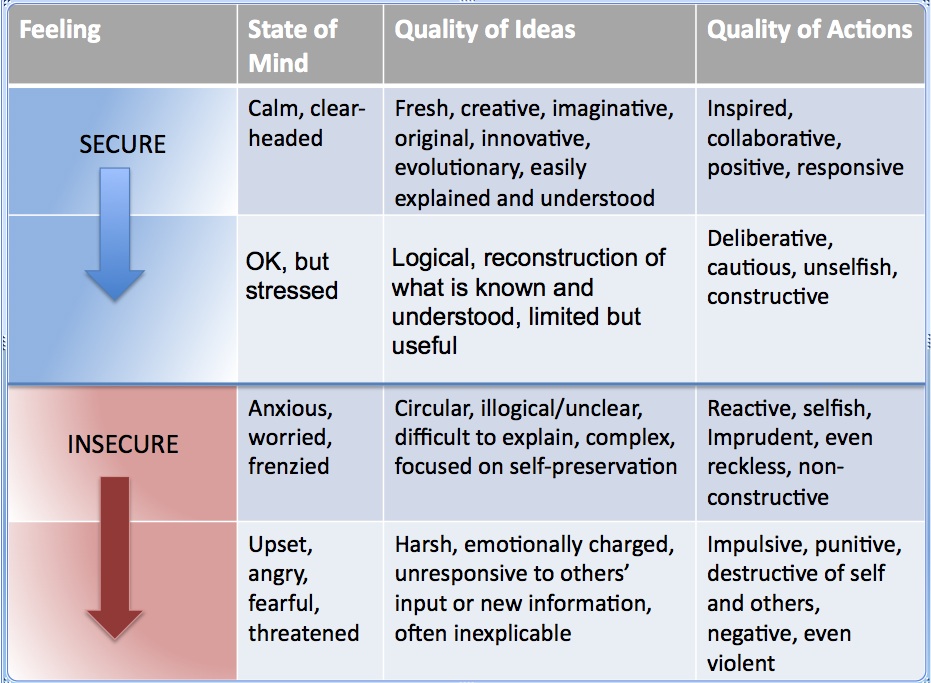
Insecurity, and all the non-constructive feelings it spawns, shoves wisdom and imagination out of its way when it overtakes our public dialogue. There is a highly predictable connection between the prevailing feeling state, or state of mind, in which we spend our time and the thinking and actions that make sense to us and seem possible to us.
It has been difficult to watch the erosion of common sense and wisdom as insecurity has infected more and more of our responses to critical issues over the past several weeks. It seems the news is filled with, and thriving on, reports of people in increasingly insecure states of mind struggling to deal with huge challenges. The missing piece in all our discussions seems to be the need for clarity, quiet minds, wisdom, insight and imagination to solve problems we've never seen before.
But there is hope in the innate and extraordinary resiliency we all share as human beings. We are always capable of dropping down from a secure state of mind that supports creative solutions to the most daunting problems, into insecurity, which blocks that capacity, as I've tried to illustrate in the chart below. But we are equally capable of turning around. At any moment, our heads clear, insight bubbles to the surface, we "see" what we're doing with out own thinking, and we can just as easily reverse the arrows and come back to peace and clarity.
What does it take? Wanting to feel less stressed; knowing that it's in us to be at ease with our thinking and elicit our highest quality ideas; trusting that the only way to keep negative thinking going is to hang onto it. As soon as we let any thought go, the natural flow of thinking resumes and the quality of our ideas and feelings, like everything else in life, moves towards balance.
Subscribe to:
Posts (Atom)